Showing posts with label Best Destinations Of The World. Show all posts

Monday, 4 October 2021

The Best Asian Discovery


It sprawls across Asia in a glittering geographical garland of 17,500 beautiful islands that stretch from sophisticated Singapore in the north to sunbaked Australia in the south. It is a crucible of the oldest religions and cultures in human history; with Hindu, Buddhist and Christian traditions enduring amidst the largest Muslim and animist communities in the world – yet its government is decidedly secular and its thriving business-world fully materialistic. Its 265 million people belong to 350 different ethnic groups and speak 530 unique languages, yet are remarkably united in national identity. The character of this amazing nation is grounded in local community, yet its outlook is increasingly global. It is a gorgeous cornucopia of colourful cultures, creeds, cuisine and crafts, and it welcomes the world with wide-open arms. This is Indonesia - The Best Asian Discovery for travel and leisure.


In a crowded and competitive travel-industry, what makes Indonesia stand out? First of all, the nation’s sheer size and strategic location ensure that ancient cultures and traditional crafts thrive in our modern technological world. Modern houses have intricate ethnic décor, and high-powered deals are finalised by tycoons in traditional batik shirts. Sleek imported sedans vie for traffic-space with horse-drawn carts, and satellite-dishes relay telecasts of ancient dramas in authentic detail. In Indonesia, culture is alive and handicraft is part of daily life. Secondly, the fact that most of the islands in this vast archipelago were relatively remote from each other in ancient times results in art, architecture, culture and cuisine being very different from place to place. This gives Indonesia a powerful ‘pull-factor’ in tourism: it is an excellent destination for repeat visits.

Indonesia is probably the world’s last great ecotourism frontier, with its varied geography and unimaginable biodiversity. Try figuring out 28,000 known species of local flowers! From the giant Rafflesia that can weigh over 10 kg, to exquisite tiny orchids as rare and as precious as any gem, Indonesia is a flowering paradise of seductive scents and sensations. Bird-watchers from all over the world fly here to spot as many of the 1500 native species that they can, mindful of the fact that Indonesia has more endemic species than any other country on the planet. There are also over 3500 species of wild animals, from ferocious carnivores like the terrifying Komodo Dragons and the mysterious Sumatran Tiger to furry friends like the appealing little Slow Loris and the gentle and intelligent Orang Utan. And still on the topic of ecotourism, we haven’t even begun to describe the underwater wonders awaiting discovery in some of the most varied and spectacular dive-sites ever known!
There are enough websites and publications that extol every detail of this great nation's tourism attractions. For us at answers!, however, one special quality stands out here - and this is the warmth and love of the Indonesian people. From the most luxurious international hotel to the humblest native dwelling, hospitality in Indonesia is spontaneous and thoroughly sincere. The harried street-hawker hustling in a traffic jam, the musical Batak troubadour at your dining-table, the busy village mother with child on her waist, the tattooed tribesman in his jungle domain, the multi-lingual European-educated boutique owner, the tired farmer trailing his buffalo home across the rice-fields - every single Indonesian you meet will give you a smile and a beaming welcome. The hospitality and friendships that await the visitor can only be experienced personally - and that, alone, should be reason enough for YOU to head for Indonesia, the Best Asian Discovery in travel!


(All pix by Andrew Ponnampalam unless otherwise stated)

Saturday, 25 July 2020

The Best Asian Mountain Experience

All over the world, mountains invoke awe and admiration, attracting visitors from far and wide. Across Asia, some mountain destinations have become global tourism icons, from the giddy heights of Nepal’s Mount Everest to the lovely snow-capped symmetry of Fuji-San in Japan.

Like both these famous peaks, several places across Asia have become popular tourism magnets. The iconic status of Malaysia’s Mount Kinabalu attracts thousands of ecotourists, hikers, climbers, birdwatchers and plain day-trippers to the Kinabalu National Park each year. Those who wish to climb the mountain itself are advised to make reservations at least six months in advance as only 135 climbers are permitted each day.
The stunning volcanic crater and spectacular sunrises at Mount Bromo in Indonesia lure a daily stream of visitors who ascend its slopes on foot, by jeep or on the hardy and lovable local ponies. India’s Doddabetta Peak is close to the beautiful montane resort of Ooty in Tamil Nadu, and has scenic views of Bandipur National Park. South Korea attracts tourists to its popular ski resorts, with our particular favourite peak being Balwangsan Mountain in Yeongpyong.
Some peaks are only accessible to the intrepid adventure-tourists and determined climbers. Mongolia’s Mount Khuiten is located in what is considered to be one of the most remote and untouched regions in the world. Visitors have to take a couple of flights, endure a rugged 400km drive, and then undertake a 17km trek just to reach the base camp of this pristine peak.
Our choice for Best Asian Mountain Experience, however, is the legendary Huangshan in China’s Anhui Province. Since ancient times, poets, painters and pundits of prose have tried to capture the dramatic magnificence of the amazing and surreal-seeming landscape. A visit to the actual place, however, shows that reality is every much as breathtakingly beautiful today as was displayed in ancient art.
Sheer rock-faces tower up to dizzying heights, actually piercing the clouds to create a visual fantasy for the stunned traveller. Solitary pine trees calmly grow out of tiny side-fissures at terrifying heights, lending a serene tone to the dramatic landscapes.  What makes Huangshan a truly memorable experience is that the most heart-stopping spots are accessible to visitors, complete with all modern facilities that an international traveller would expect!

Over time, several routes with over 60,000 steps have been hewn on the sheer granite faces of Huangshan. Climbers take between 3 to 7 hours but porters laden with huge loads of things like furniture, refrigerators, building material and other heavy items can take a back-breaking 12 hours. For savvy and well-heeled tourists, however, there are three spectacular cable-car routes, each taking between 10 to 12 minutes.
At the foot of Huangshan and along the access highways there are numerous accommodation-options ranging from luxury hotels to spartan backpacker hostels. For us, however, the most memorable part of our Huangshan experience was staying at the small but well-appointed hotels built decades ago on the giddy heights of the legendary peak. Nestling in nooks and crannies of the magnificent mountain, they provide quintessential Chinese hospitality with surprisingly excellent service.
Stunning scenery, spectacular sunsets, dramatic landscapes and unexpected levels of hospitality are just some of the elements that make China’s Huangshan our choice for Best Asian Mountain Experience!

Photographs © Phosamos, Patricia Malina, Jade Screen Hotel

Monday, 29 April 2019

The Best Hidden Arabian Destination


Speak of an Arabian destination, and places like Qatar, Dubai and Abu Dhabi immediately come to mind. This is largely due to the influential international airlines these countries own, which carry passengers from all corners of the globe to their strategic air-hubs. Other destinations like Iran, Saudi Arabia and Syria are known largely for their prominent positions on the global political landscape, while places like Kuwait and Iraq command international awareness for their rich petroleum resources. 

Tourists do flock to the picturesque attractions of Morocco and Jordan, but to us there is a hidden tourism treasure tucked away at the north-east of the United Arab Emirates that is largely unknown and unappreciated.  This is the little kingdom of Fujairah, one of the seven emirates of the UAE.
Relatively secluded from the world since ancient times, this delightful diminutive emirate is still relatively isolated, relying mainly on air-links from Abu Dhabi and a highway to Dubai for tourism; despite its having an excellent deep-water port at Fujairah city.
The drive along the ultra-modern Sheikh Khalifa Highway from Dubai is a pretty fascinating experience, passing through vast desert landscape as it connects Dubai with photogenic places in Sharjah, Ras Al Khaimah and Fujairah. Officially inaugurated in December 2011 to celebrate the 40th Anniversary of the UAE, the 45-kilometre (28 mile) highway takes just 30 minutes to cover non-stop. For our visit to Fujairah in 2012, we flew from Abu Dhabi. This gave us an equally fascinating bird’s eye view of the dramatic coastline of pristine beaches and dramatic rocky cliffs that form Fujairah’s entire eastern border.

Some of the memorable sightseeing spots in this idyllic Arabian hideaway include the imposing Hajar Mountains, the sheer cliffs of Dibba, the quaint village of Masafi with its traditional Friday market, the Ain al-Madhab Hot Springs, the Wadi al-Wurayah oasis with its spectacular waterfall and the ancient mud-brick Al-Bidayah Mosque,the oldest in the entire UAE. Gorgeous beaches line this destination, with pretty impressive dive-sites out in the crystal-clear waters of the Gulf of Oman.
Around Fujairah city itself, you can visit the 17th century Fujairah Fort, the massive Sheikh Zayed Mosque, the fascinating Fujairah Museum,
the giant golden tea-set and stylised giant eagle statues, and various historic sites. Accommodation ranges from affordable city hotels to spectacular seaside luxury resorts. 
From an Aqua Bounce Funpark and parasailing to shopping at air-conditioned malls and traditional souks, from heart-pounding 4WD wadi-bashing to serene wellness spas, there is something for everyone in Fujairah, our Best Hidden Arabian Destination!


Pix © Odyfolio. Andrew Ponnampalam

Saturday, 9 March 2019

The Biggest Waterfalls In The World

Waterfalls always make for spectacular tourist-attractions, exciting the senses with a combination of breathtaking sight, overpowering sound, exhilarating spray, impressive vibration, and often a unique potpourri of scents.

From the towering Angel Falls in Venezuela with an uninterrupted height of 979 metres (3,212 ft) to the broad 10783-metre (35,376 ft) span of the Khone Falls on the border between Laos and Cambodia, waterfalls have always amazed mankind since the dawn of time.
Whether you are at remote cataracts like Dyanjandi in Iceland or at crowded sightseeing favourites like the Niagara Falls on the USA/Canada border, you will be spellbound by the majesty and power of natural cascades. From the shocking deep-red Blood Falls in Antarctica to the brilliant multi-coloured hues of Colombia’s Caño Cristales Rapids and the eye-catching rainbows dancing about a myriad other waterfalls around the world, colours are part of the attraction when water tumbles from one level to another.

Our choice of the best waterfalls in the world are also the largest. The Victoria Falls that straddle the border between Zimbabwe and Zambia are the biggest singular waterfall in the world, with a width of 1.7 kilometres, a height of 108 metres, and an average flow of a massive 1 million litres of water per second!
On our visit to Zimbabwe, we learnt that these impressive waterfalls are most commonly known as “mosi-oa-tunya” or “the smoke that thunders”. Since ancient times, this tremendous natural phenomenon has been identified from miles away by the perpetual cloud of spray and the deep rumble of its cascading torrent. Considered one of the seven natural wonders of the world and a UNESCO World Heritage site, two-thirds of Victoria Falls lie within Zimbabwe, which also has the most vantage points.
For a variety of reasons, much of the Victoria Falls National Park has been left in its natural state, apart from broad cemented paths and a large Interpretive Centre at the entrance.  While families with small children need to be aware of the ‘wilderness environment’ awaiting them, we find that the lush natural habitat adds to the allure and adventure of the experience at Victoria Falls, the Largest Waterfalls In The World!

(Photographs by Andrew Ponnampalam)

Thursday, 6 December 2018

The Best South Asian Birding Destination

The vast region of South Asia is a paradise for ecotourists, and birdwatchers in particular have a field day. From the giddy heights of northern Nepal to the scenic south of Sri Lanka, and from Pakistan in the west to the east of Bangladesh there are rich ecotourism destinations with bird-species galore.
In India alone, there are world-class bird-watching destinations in numerous states, but our particular favourite is a relatively unheralded triumph of local government and community-led conservation efforts at the very southern tip of India.
To us, The Best South Asian Birding Destination is the Suchindram Kulam Wetlands in Tamil Nadu.
We have chosen this hidden treasure for several reasons.
First is its unique location. As part of the Suchindram-Theroor-Manakudy Conservation Reserve, this area underlies the southernmost continental range of the Central Asian Flyway. About two-thirds of Kanyakumari District consists of lowland plains dotted with over 2000 freshwater kulam or ponds. 
The second is its rich biodiversity. Although it has a few small mammals such as flying squirrels, giant fruit-bats, macaques, otters and the rare Malabar Giant Squirrel, this Conservation Reserve has an impressive array of plant-life, ranging from towering mangrove trees to over 110 species of tiny aquatic flowering plants. Its large variety of aquatic vegetation includes water-lilies, lotus, floating-hearts,  water-plantains, arrowheads, cat-tail reeds and other water-plants that attract birdlife. 
The main attraction of the Conservation Reserve, of course, is its variety of birdlife. About 250 bird-species have been recorded in the district, including both migrants and residents.  4 species are relatively rare or threatened, while another 12 are endemic. A few tall trees and bushes on a central island have become a natural safe roosting-place for breeding birds such a Black-headed Ibis, Spot-billed Pelicans and Painted Storks, forming a precious ecosystem that has flourished since the area was officially designated a Conservation Reserve.
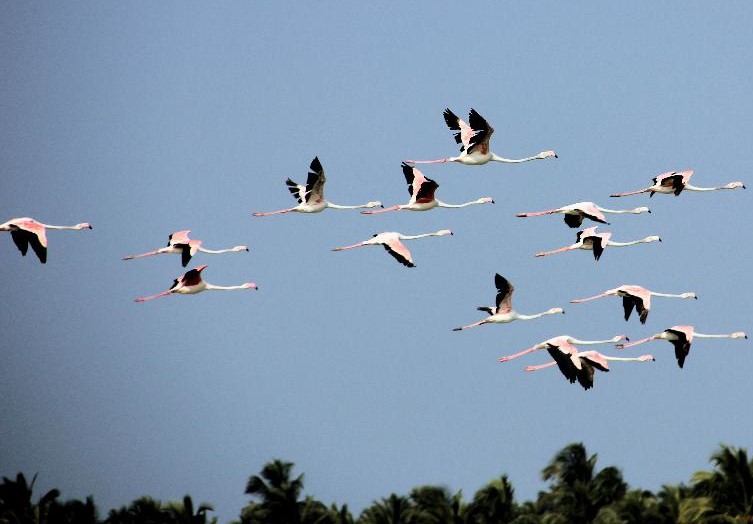
However, what stunned us on our visit to Suchindram Kulam was the sheer quantity of birdlife! There were literally hundreds of waterbirds, large and small, crowding the wetlands. It was a stunning sight. We were informed that birds such as Greater Flamingo, Northern Pintails, Common Teals, Spotbill Ducks, Bronze-winged Jacanas, Whiskered Terns, Little Terns, Black-Winged Stilts and Pheasant-tailed Jacanas have been recorded in the greater Conservation Reserve, while species such as Gargeneys, Pintails, Ruffs, Reaves, Coots and Little Stints have sometimes been recorded in their thousands.    
What specially inspired us about Suchindram Kulam however, was the splendid community-led effort that led to its conservation. In 1988, local resident  and renown ornithologist Dr. Robert B. Grubh of nearby Nagercoil initiated a proposal for the conservation and management of Suchindram-Theroor-Manakudy wetland complex in cooperation with global organisations such as Birdlife International , The Nature Conservancy, World Wildlife Fund (WWF), Wild Bird Society of Japan, the World Resources Institute, and the United States Agency for International Development.
Although some traditional fisherfolk and farmers had initial misgivings, the majority were eventually won over by the passionate efforts of a large number of local people ranging from schoolchildren and undergraduates to village-folk and pensioners who were engaged in wetlands conservation.  Community workshops, local television broadcasts, field-demonstrations, press-coverage, school-programmes, and intense personal efforts were utilised in the local languages to raise conservation-awareness.  
Most importantly, visionary local government leaders swung into action. The Tamil Nadu Forest Department, District Collectors, the Public Works Department, Village Panchayats (Councils) and other local and regional government entities have supported the conservation efforts. The synergy of local people and government in effective conservation is exemplary!  
The practical benefits of nurturing the area’s rich local natural heritage are now being realised, and today the Tamil Nadu Tourism blogspot has a prominent feature on the Suchindram-Theroor-Manakudy Conservation Reserve  – showcasing this exquisite ecotourism gem to the world. What a source of pride for the state of Tamil Nadu!   
If the Tamil Nadu Forest Department continues its serious efforts to protect this area while providing visitor-friendly amenities such as tourism-information kiosks, car-parks, public toilets and well-managed nature-trails, we believe that Suchindram Kulam and the rest of the Suchindram-Theroor-Manakudy Conservation Reserve could continue to be The Best South Asian Birding Destination for generations to come!  

 (All photographs by Dr. Robert B.Grubh)

Friday, 19 October 2018

The Best Public Park

Public Parks are often regarded as mundane necessities of urban planning, but in some cities, a public park has become a beloved landmark and a destination in itself, enhancing the city in which it is situated.

Some well-known public parks in major global cities have matured into classics of greenery, rest and recreation like Regent’s Park in London and New York’s Central Park.  In this category, we like 400-hectare King’s Park in Perth, Australia, which is a serene and scenic mixture of landscaped parkland, fascinating botanical gardens and wild, untamed natural bushland. Gorgeous views of the Swan River and glistening city skyline add to the charm of one of the largest inner-city parks in the world.

Other public parks have become iconic for the people and programmes that bring a unique buzz of zing and zest! Our favourite in this category is Tokyo’s Yoyogi Park on weekends, when an amazing number of subcultures and countercultures manifest in different parts of the park. From classic-car buffs and proud owners of dressed-up dogs to Elvis impersonators and sinister-looking Goths, to small chamber orchestras, bopping break-dancers and hyperactive clowns, people transform Yoyogi into a must-see destination.

Our choice of the World’s Best Public Park, however, is one of its newest and probably most unlikely in location. This is the Gathering Place Community Park in Tulsa, Oklahoma. A daring vision, coupled with years of planning, generous donations and active input from the local community have transformed 100 acres of scenic waterfront along the lovely Arkansas River into an innovative, unconventional and thoroughly delightful interactive environment.
Opened in September 2018, the Gathering Place is fast-becoming a magnet far beyond the immediate vicinity of Tulsa. We predict that this stunning and ever-evolving experience will become a major tourism attraction, transforming the image of this unprepossessing city – which, by the way, also has some of the most fascinating, educational and child-friendly museums/libraries/interpretive-centres in the world.
Friends with children tell us that their offspring have gleefully reported no less than eleven different slides in various parts of the park as well as an amazing mirror-maze, “old-looking holes in walls you can climb through and real musical-instruments hanging in the air”(sic), plus details of a fantastical Fairyland Forest that kept them talking excitedly for weeks afterwards. They ain’t seen nothing yet! The reality at the Gathering Place actually transcends imagination – seriously.
The Land Of The River Giants, Spiral Connector, Chapman Adventure Playground, Skywalk Forest, Volcanoville, Ramble Sensory Garden, Cottonwood Lawn, Charlie’s Water-Mountain, Picnic Grove, Oneok Boathouse, Williams Lodge, Yvette’s Global Rainbow, Peggy’s Pond and The Reading Tree are just come of the wonderful attractions, all entirely free!
What ‘sealed the deal’ for us are the caring touches for the less fortunate. Visitors with disabilities are delighted to discover thoughtful features that include dedicated parking-lots and toilets, Ultra ADA Pads, braille signs, wheelchair-accessible dining counters and specially-designed seating throughout the Gathering Place.  All park entrances, pathways, bridges, lawns and gardens as well as some drinking-fountains are disabled-accessible.  The food-items sold here include vegan and allergy-friendly options. The Management also invites guests on the autism spectrum to use spaces provided in the Gathering Place to overcome sensory anxieties.
Foodies and hungry guests find “exciting eating opportunities” at The Patio, Redbud Café, Vista@The Boathouse, and a constantly-changing array of food-trucks, kiosks and food-carts. Add the pretty scenery around the Gathering Place, top up everything with a regular stream of imaginative and absorbing events and activities, and you have a really outstanding destination that we believe is the World’s Best Public Park!
Photographs: ©Alex S. Maclean, ©Shane Bevel Photography, ©Gathering Place

Monday, 4 December 2017

The Best Destination For Enchantment

Image result for TasmaniaThe Destination With The Best Enchantment is the lovely island of Tasmania in Australia. Vistas of stunning beauty are everywhere, though it is the leisurely traveller who will discover them. Places like Freycinet and Cradle Mountain are just some spots where the patient traveller will have moments of heart-stopping serendipity – so graceful and idyllic are the surroundings. The changing light at dusk or in the fall can create truly magical scenes, but budding photographers will find picture-perfect scenes all over the island. Beaches or buildings , farmlands or forests, mountains or marinas – everything seems ideally picturesque in Tasmania.

Even the animals seem especially enchanting. We had wonderful views of eagles swirling in aerial courtship, and wallabies in abounding conference. Warblers waited to be photographed and normally-elusive beetongs scurried away into the bush only after we saw them clearly. A deceptively innocent-looking possum politely stood on my porch trying to get invited inside my chalet, and an exceptionally enormous wild wombat placidly munched grass at my feet like a tame sheep in the gathering dusk.

People are friendly, too, and genuinely pleased to meet you. They take time to chat, and to share local lore on the bakery with tastiest meat-pies or the best vantage point for a photograph. In 2005 Tassie seemed to be what New Zealand was like twenty years earlier – rustic, scenic, unhurried and uncrowded.  Places like Launceston have immaculately preserved their old buildings, and the fact that our visit to Tasmania coincided with a vintage-car rally simply evoked a bygone era with exquisite vibrancy.
Image result for Cary LewincampThe fresh flavour of the seafood in Tasmania ranks among the best in Australia, and the haunting loveliness of Cary Lewincamp’s guitar music among the finest of its kind in the world. Like a rare wine or a precious work of art, the true beauty of this southerly hideaway can only be experienced languidly and thoughtfully.

For those who will vacation quietly, carefully and expectantly, there is an awaiting blessing called Tasmania.

(Images by Buzzfeed.com and other sources) 

Wednesday, 12 July 2017

The Best Destination For Music


In a world that is becoming increasingly smaller through travel and the electronic media, music is the universal language that crosses boundaries today with rhythmic regularity. It is as easy to find an excellent old-time Dixieland jazz-club in Shanghai as it is to find a Cantonese pop-music concert in London, and there always seems to be an African dance presentation going on somewhere in Berlin just as classical Western music performances seem to be available in Singapore at any time of the year. Exquisite Spanish-guitar virtuso performances can be heard throughout the Philippines, and authentic Indian dance-performances proliferate off the African coast, on the island of Mauritius. Various cities across the globe have their own distinctive music festivals and the avid music-tourist is often overwhelmed with choices.

Experienced globe-trotters and savvy travel-professionals, however, point to just one country if asked to identify a tourism destination that is defined by music more than anything else. It is a country with superb classical architecture, stunning scenery, fascinating cuisine, some very good wines, great sports facilities - and oh yes, sublime local coffee! It has an air-hub par excellence, and both road and rail infrastructure to equal any place in the world - yet all these winning tourism features are overshadowed by the sound of music. This is Austria, the country that enchants visitors with auditory delights like nowhere else on earth.

Tourists from all over the world flock to Austria to tramp the paths and film-locations where the screen Von-Trapp Singers immortalised The Sound Of Music, and soak up the melodies of Rodgers & Hammerstein. They visit the birthplaces, homes and old haunts of great Western composers such as Brahms, Mozart, Hayden, Schubert, Schumann, and Wagner. They relive the glories of these great musicians, and luxuriate in the timeless melodies.They witness performances of Strauss and Strauss, and thrill to the wonder of the fairy-tale Viennese Waltz. They watch the cherubic faces of the Vienna Boys Choir and revel in the purity of those incandescent voices. On these great musical attractions alone, any nation could have a dynamic and world-class tourism industry. But Austria has much, much more to offer!

There are the often overlooked genres of traditional Austrian music such as Old Farmhouse, Schrammel and Alpine, each with their quintessential Austrian distinctiveness and allure. There are the evocative melodies of neighbouring countries such as Hungary, Slovenia, Slovakia and the Czech Republic as well as other nations in and around the Danube-Danau region. There are festivals dedicated to a single instrument, and these can include anything and everything from the Gypsy Accordion to the Australian Didgeridoo. Austria also hosts events celebrating jazz, opera, tango, new folk, and even Brass Band - the latter attracting participants from at least 15 nations around the globe.


During a single visit to Austria in early 2009, I picked up an events-magazine and read publicity for performances of Contemporary music such as Cabaret, Café’ Concerts, Electronic, Funk, Hip-Hop, Jazz, Opera, Operetta, Pop, Rock, World Music and Funk Mundial, the cosmopolitan electronic Brazilian-styled dance rhythms. There were also performances of International music from places as diverse as the Balkans, Ukraine, Egypt, Spain, Texas(!), New York’s Harlem, Serbia, and various parts of Asia. Salzburg’s Summer Scene had Indian Classical music among its offerings, and Vienna’s Volksoper was staging Chinese Opera. And we haven't even started to talk about the glorious Christian Sacred Music that I personally find inspiring and rejuvenating...
Yes, music permeates the very fabric of Austria - it flows down its Alpine brooks and swings through its concert-halls with exhilarating freedom and diversity. Music defines much of Austria's history, and energises much of its present-day life. And for the intrepid tourist, it makes Austria The Best Music Destination In The World.


All images courtesy of Austria National Tourism Organisation
© Österreich Werbung / Trumler, © Österreich Werbung / Fankhauser, © Österreich Werbung / H.Wiesenhofer
© Österreich Werbung / Wiesenhofer

Sunday, 17 January 2016

The Best Safari Destination

When I was very young, Africa burst upon my imagination with the debut of the blockbuster movies Hatari! and Born Free which brought the grandeur of the African savannah to us in larger-than-life Technicolor wide-screen, complete with stirring music and often unscripted drama from the animals. Add a good dose of Tarzan books, and I was completely enamoured with the whole adventure of an African safari.
When preparing for my first visit to Africa, my mind was racing with questions. Was the legendary savannah still unspoilt? Would it be as grand as or even greater than what I saw on the screen? Were the numerous TV documentaries reflective of the true situation? Would I actually get to see many wild animals? I soon found out that the answer to each and every question was a resounding Yes. The fabled natural habitats of Kenya remain green, clean and vast – far greater in scope and beauty than anything the silver-screen could convey. And as for wildlife, nothing could have possibly prepared me for what actually happened.

 From herbivores like the African Elephant, Cape Buffalo, Warthog , Masai and Reticulated Giraffes, Burchell’s Zebra, Scrub Hare, Hippopotamus and White Rhinoceros to carnivores like the Lion, Cheetah, Hyena, Jackal, Wild Dog and Leopard, mammals could be seen at close quarters from the open-sided jeeps that cruise the vast natural habitats of Kenya.
Of the antelope or deer genus alone, we saw large numbers of Impala, Grant’s Gazelle, Thompson’s Gazelle, Topi, Wildebeest and Common Waterbuck, while also managing to spot less common species like the Hartebeest, Bushbuck, Defassa Waterbuck, Bohor  Reedbuck, the tiny Kirk’s Dik-Dik and the enormous cow-sized Eland. Omnivores like the Banded Mongoose and Baboon helped us notch up a list of about thirty magnificent mammal-species of all shapes and sizes in the four days we were on full safari in different parts of Kenya. The highlight of the trip was an accidental once-in-a-lifetime close encounter with an enormous lion!

Since then, I have travelled across various parts of Africa, and seen some amazing sights. But for the Best Safari Destination in my experience, it has to be Kenya – by far.

(All photographs by Andrew Ponnampalam)