Showing posts with label Asia. Show all posts

Monday, 4 October 2021

The Best Asian Discovery


It sprawls across Asia in a glittering geographical garland of 17,500 beautiful islands that stretch from sophisticated Singapore in the north to sunbaked Australia in the south. It is a crucible of the oldest religions and cultures in human history; with Hindu, Buddhist and Christian traditions enduring amidst the largest Muslim and animist communities in the world – yet its government is decidedly secular and its thriving business-world fully materialistic. Its 265 million people belong to 350 different ethnic groups and speak 530 unique languages, yet are remarkably united in national identity. The character of this amazing nation is grounded in local community, yet its outlook is increasingly global. It is a gorgeous cornucopia of colourful cultures, creeds, cuisine and crafts, and it welcomes the world with wide-open arms. This is Indonesia - The Best Asian Discovery for travel and leisure.


In a crowded and competitive travel-industry, what makes Indonesia stand out? First of all, the nation’s sheer size and strategic location ensure that ancient cultures and traditional crafts thrive in our modern technological world. Modern houses have intricate ethnic décor, and high-powered deals are finalised by tycoons in traditional batik shirts. Sleek imported sedans vie for traffic-space with horse-drawn carts, and satellite-dishes relay telecasts of ancient dramas in authentic detail. In Indonesia, culture is alive and handicraft is part of daily life. Secondly, the fact that most of the islands in this vast archipelago were relatively remote from each other in ancient times results in art, architecture, culture and cuisine being very different from place to place. This gives Indonesia a powerful ‘pull-factor’ in tourism: it is an excellent destination for repeat visits.

Indonesia is probably the world’s last great ecotourism frontier, with its varied geography and unimaginable biodiversity. Try figuring out 28,000 known species of local flowers! From the giant Rafflesia that can weigh over 10 kg, to exquisite tiny orchids as rare and as precious as any gem, Indonesia is a flowering paradise of seductive scents and sensations. Bird-watchers from all over the world fly here to spot as many of the 1500 native species that they can, mindful of the fact that Indonesia has more endemic species than any other country on the planet. There are also over 3500 species of wild animals, from ferocious carnivores like the terrifying Komodo Dragons and the mysterious Sumatran Tiger to furry friends like the appealing little Slow Loris and the gentle and intelligent Orang Utan. And still on the topic of ecotourism, we haven’t even begun to describe the underwater wonders awaiting discovery in some of the most varied and spectacular dive-sites ever known!
There are enough websites and publications that extol every detail of this great nation's tourism attractions. For us at answers!, however, one special quality stands out here - and this is the warmth and love of the Indonesian people. From the most luxurious international hotel to the humblest native dwelling, hospitality in Indonesia is spontaneous and thoroughly sincere. The harried street-hawker hustling in a traffic jam, the musical Batak troubadour at your dining-table, the busy village mother with child on her waist, the tattooed tribesman in his jungle domain, the multi-lingual European-educated boutique owner, the tired farmer trailing his buffalo home across the rice-fields - every single Indonesian you meet will give you a smile and a beaming welcome. The hospitality and friendships that await the visitor can only be experienced personally - and that, alone, should be reason enough for YOU to head for Indonesia, the Best Asian Discovery in travel!


(All pix by Andrew Ponnampalam unless otherwise stated)

Saturday, 25 July 2020

The Best Asian Mountain Experience

All over the world, mountains invoke awe and admiration, attracting visitors from far and wide. Across Asia, some mountain destinations have become global tourism icons, from the giddy heights of Nepal’s Mount Everest to the lovely snow-capped symmetry of Fuji-San in Japan.

Like both these famous peaks, several places across Asia have become popular tourism magnets. The iconic status of Malaysia’s Mount Kinabalu attracts thousands of ecotourists, hikers, climbers, birdwatchers and plain day-trippers to the Kinabalu National Park each year. Those who wish to climb the mountain itself are advised to make reservations at least six months in advance as only 135 climbers are permitted each day.
The stunning volcanic crater and spectacular sunrises at Mount Bromo in Indonesia lure a daily stream of visitors who ascend its slopes on foot, by jeep or on the hardy and lovable local ponies. India’s Doddabetta Peak is close to the beautiful montane resort of Ooty in Tamil Nadu, and has scenic views of Bandipur National Park. South Korea attracts tourists to its popular ski resorts, with our particular favourite peak being Balwangsan Mountain in Yeongpyong.
Some peaks are only accessible to the intrepid adventure-tourists and determined climbers. Mongolia’s Mount Khuiten is located in what is considered to be one of the most remote and untouched regions in the world. Visitors have to take a couple of flights, endure a rugged 400km drive, and then undertake a 17km trek just to reach the base camp of this pristine peak.
Our choice for Best Asian Mountain Experience, however, is the legendary Huangshan in China’s Anhui Province. Since ancient times, poets, painters and pundits of prose have tried to capture the dramatic magnificence of the amazing and surreal-seeming landscape. A visit to the actual place, however, shows that reality is every much as breathtakingly beautiful today as was displayed in ancient art.
Sheer rock-faces tower up to dizzying heights, actually piercing the clouds to create a visual fantasy for the stunned traveller. Solitary pine trees calmly grow out of tiny side-fissures at terrifying heights, lending a serene tone to the dramatic landscapes.  What makes Huangshan a truly memorable experience is that the most heart-stopping spots are accessible to visitors, complete with all modern facilities that an international traveller would expect!

Over time, several routes with over 60,000 steps have been hewn on the sheer granite faces of Huangshan. Climbers take between 3 to 7 hours but porters laden with huge loads of things like furniture, refrigerators, building material and other heavy items can take a back-breaking 12 hours. For savvy and well-heeled tourists, however, there are three spectacular cable-car routes, each taking between 10 to 12 minutes.
At the foot of Huangshan and along the access highways there are numerous accommodation-options ranging from luxury hotels to spartan backpacker hostels. For us, however, the most memorable part of our Huangshan experience was staying at the small but well-appointed hotels built decades ago on the giddy heights of the legendary peak. Nestling in nooks and crannies of the magnificent mountain, they provide quintessential Chinese hospitality with surprisingly excellent service.
Stunning scenery, spectacular sunsets, dramatic landscapes and unexpected levels of hospitality are just some of the elements that make China’s Huangshan our choice for Best Asian Mountain Experience!

Photographs © Phosamos, Patricia Malina, Jade Screen Hotel

Thursday, 6 December 2018

The Best South Asian Birding Destination

The vast region of South Asia is a paradise for ecotourists, and birdwatchers in particular have a field day. From the giddy heights of northern Nepal to the scenic south of Sri Lanka, and from Pakistan in the west to the east of Bangladesh there are rich ecotourism destinations with bird-species galore.
In India alone, there are world-class bird-watching destinations in numerous states, but our particular favourite is a relatively unheralded triumph of local government and community-led conservation efforts at the very southern tip of India.
To us, The Best South Asian Birding Destination is the Suchindram Kulam Wetlands in Tamil Nadu.
We have chosen this hidden treasure for several reasons.
First is its unique location. As part of the Suchindram-Theroor-Manakudy Conservation Reserve, this area underlies the southernmost continental range of the Central Asian Flyway. About two-thirds of Kanyakumari District consists of lowland plains dotted with over 2000 freshwater kulam or ponds. 
The second is its rich biodiversity. Although it has a few small mammals such as flying squirrels, giant fruit-bats, macaques, otters and the rare Malabar Giant Squirrel, this Conservation Reserve has an impressive array of plant-life, ranging from towering mangrove trees to over 110 species of tiny aquatic flowering plants. Its large variety of aquatic vegetation includes water-lilies, lotus, floating-hearts,  water-plantains, arrowheads, cat-tail reeds and other water-plants that attract birdlife. 
The main attraction of the Conservation Reserve, of course, is its variety of birdlife. About 250 bird-species have been recorded in the district, including both migrants and residents.  4 species are relatively rare or threatened, while another 12 are endemic. A few tall trees and bushes on a central island have become a natural safe roosting-place for breeding birds such a Black-headed Ibis, Spot-billed Pelicans and Painted Storks, forming a precious ecosystem that has flourished since the area was officially designated a Conservation Reserve.
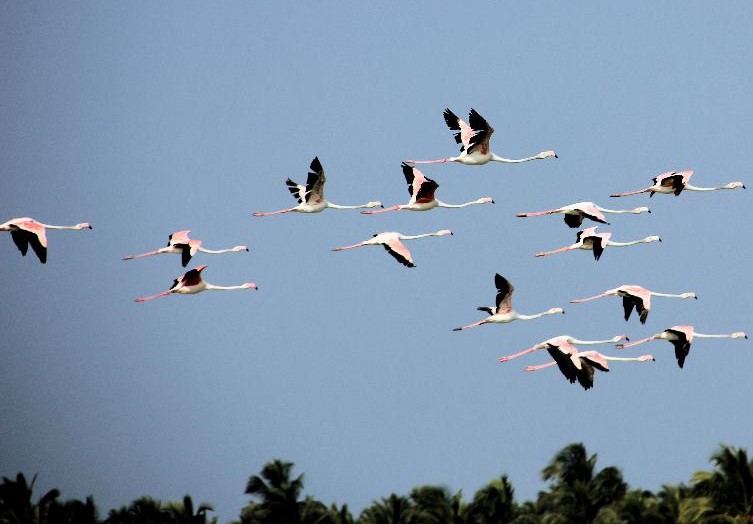
However, what stunned us on our visit to Suchindram Kulam was the sheer quantity of birdlife! There were literally hundreds of waterbirds, large and small, crowding the wetlands. It was a stunning sight. We were informed that birds such as Greater Flamingo, Northern Pintails, Common Teals, Spotbill Ducks, Bronze-winged Jacanas, Whiskered Terns, Little Terns, Black-Winged Stilts and Pheasant-tailed Jacanas have been recorded in the greater Conservation Reserve, while species such as Gargeneys, Pintails, Ruffs, Reaves, Coots and Little Stints have sometimes been recorded in their thousands.    
What specially inspired us about Suchindram Kulam however, was the splendid community-led effort that led to its conservation. In 1988, local resident  and renown ornithologist Dr. Robert B. Grubh of nearby Nagercoil initiated a proposal for the conservation and management of Suchindram-Theroor-Manakudy wetland complex in cooperation with global organisations such as Birdlife International , The Nature Conservancy, World Wildlife Fund (WWF), Wild Bird Society of Japan, the World Resources Institute, and the United States Agency for International Development.
Although some traditional fisherfolk and farmers had initial misgivings, the majority were eventually won over by the passionate efforts of a large number of local people ranging from schoolchildren and undergraduates to village-folk and pensioners who were engaged in wetlands conservation.  Community workshops, local television broadcasts, field-demonstrations, press-coverage, school-programmes, and intense personal efforts were utilised in the local languages to raise conservation-awareness.  
Most importantly, visionary local government leaders swung into action. The Tamil Nadu Forest Department, District Collectors, the Public Works Department, Village Panchayats (Councils) and other local and regional government entities have supported the conservation efforts. The synergy of local people and government in effective conservation is exemplary!  
The practical benefits of nurturing the area’s rich local natural heritage are now being realised, and today the Tamil Nadu Tourism blogspot has a prominent feature on the Suchindram-Theroor-Manakudy Conservation Reserve  – showcasing this exquisite ecotourism gem to the world. What a source of pride for the state of Tamil Nadu!   
If the Tamil Nadu Forest Department continues its serious efforts to protect this area while providing visitor-friendly amenities such as tourism-information kiosks, car-parks, public toilets and well-managed nature-trails, we believe that Suchindram Kulam and the rest of the Suchindram-Theroor-Manakudy Conservation Reserve could continue to be The Best South Asian Birding Destination for generations to come!  

 (All photographs by Dr. Robert B.Grubh)

Saturday, 23 November 2013

The Best Hotel With Traditional Ethnic Identity

The Hotel With the Best Traditional Ethnic Identity is the delightful Misiliana Hotel in Toraja, Indonesia. Nestled in the scenic Toraja Highlands of Sulawesi, this enchanting resort was built nearly four decades ago in authentic traditional Torajan style. It is staffed entirely by local tribal-folk, and everything here is genuinely native, from the ethnic Tongkonan architecture to the local village-style layout of the resort. Even the food served here is truly local – while the comprehensive menu encompasses both Western and Torajan dishes, the chefs are local people and both vegetables and fish come fresh from the ponds and organic farm-plots within this extensive resort itself! The family is the primary social structure in Torajan society. Each village is one extended family, the seat of which is the traditional Tongkonan house with its distinctive large boat-shaped roof. The elders of each household maintain village unity and nurture its traditions. In keeping with these ancient traditions, the Misiliana Hotel is family-owned and the daily management is presided over by the clan matriarch, her daughter and son-in-law. While maintaining international standards and practices in running the hotel, the family integrates the unique Torajan Christian faith and ancient local culture into administrative matters such as staff-relations, property maintenance and finance. Management cannot get more ethnic than this!
What really enchanted us was how this familial tradition creates a natural warmth and hospitality within Misiliana. Every guest is treated as a friend of the family, and the staff greet you with a mixture of professional deference and spontaneous cheerfulness. From humble gardener to regal matriarch, they are really glad you came! Inside the picturesque two-storied Tongkonan houses, each of the 96 rooms at this 3-star property has a terrace and all the mod-cons one could wish for. The lush 8-hectare grounds include lovely landscaped gardens, two attractive swimming pools, jogging tracks, a kiddies’ fishing pond, vegetable gardens, tennis courts, a fitness centre and idyllic farm ponds with quiet ‘thinking spots’. Add majestic mountains for a scenic backdrop, and you have one of our favourite hotels in the world!

All pix by Andrew Ponnampalam